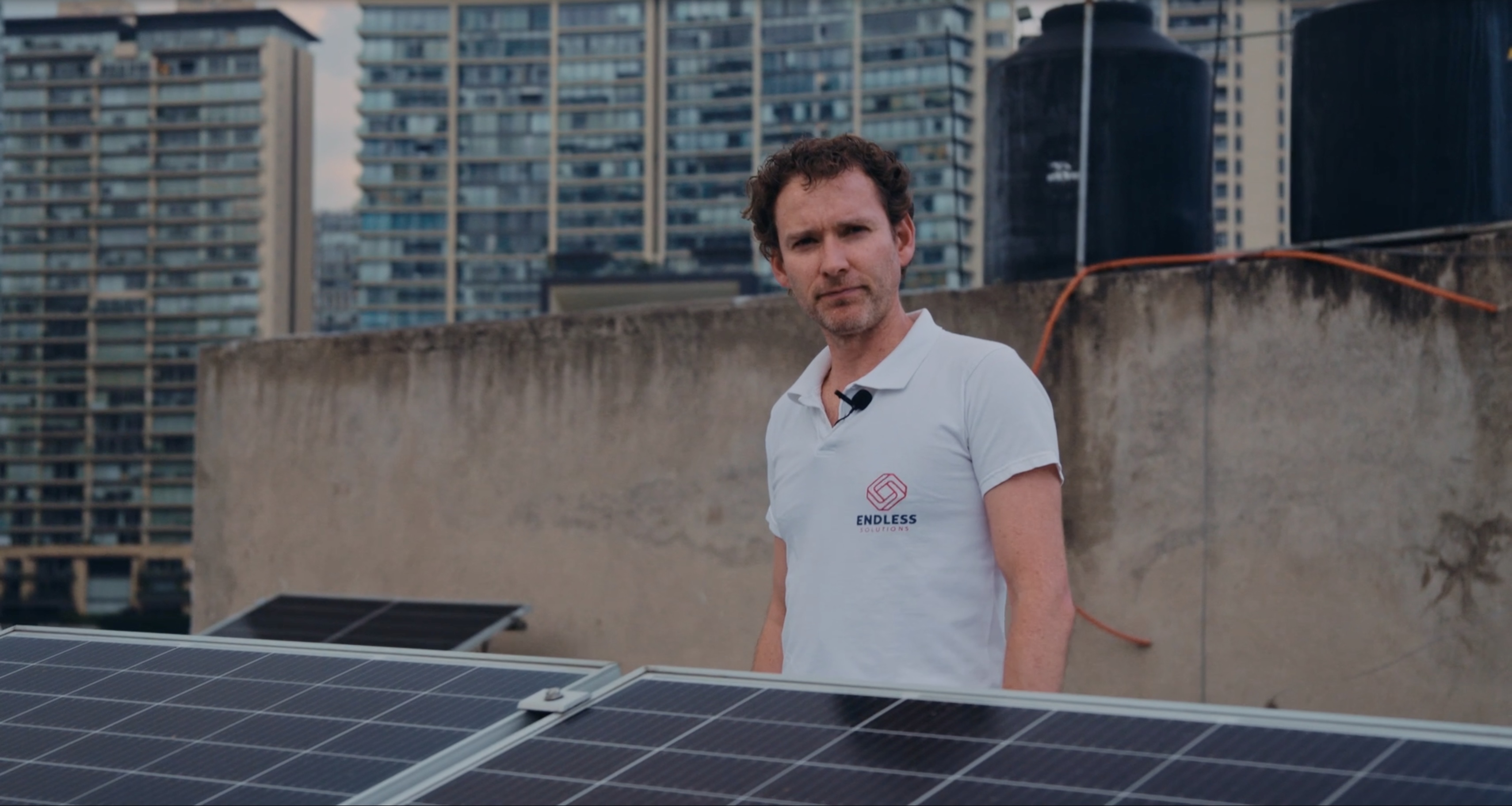
Introducing Popular Profiles: How Endless Solutions grew out of of founder Barry Cooper's own rooftop
Fifteen years ago, Barry Cooper Senosiain taught himself to install solar panels on his own roof, because he couldn't find anyone he trusted to do it. A neighbor asked him to do theirs, then another, and that is how Endless Solutions was born. Today Barry runs a growing EPC with more than 6 MWp under management and a team of fewer than ten, and he still drives to the sites and answers his customers' calls himself. This is his story: the thing he saw as a kid that stayed with him, why he bet a stable career on a rooftop, and how he now manages thousands of installations while keeping the closeness that built the business.
How Barry Cooper Senosiain went from wiring panels onto his own roof to running one of Mexico's sharpest solar EPCs, and why he still cares about every installation like it's the one on his own house.
Barry Cooper Senosiain's first goal was a modest one: to put solar panels on his own house.
That was more than fifteen years ago, when almost no one in Mexico was talking about rooftop solar. The one quote he got was expensive, the payback made no sense, and he had no one he trusted to do the work, so he set out to learn it himself. He studied, trained, and installed the system on his own roof. "It worked really well," he remembers. "We saw it wasn't that hard, and pretty soon someone asked us to do theirs. That's how the business was born."
The conviction came from much further back. "For me, the passion was always the environment," Barry says. As a kid, he'd chase smokers out of the house and feel something turn at the sight of a factory's smoke or a bag of trash on the beach. "I think that's where the passion started." Decades later, when solar became a business, it carried that same childhood thread forward.
The wall every growing EPC hits
For years, Endless Solutions grew the way good local businesses grow: one satisfied customer at a time. "A happy client speaks well of you and brings you more clients," Barry says. He knew his customers personally, drove to the sites himself, and treated every installation "as if it were the one I did on my own house fifteen years ago."
Solar rewards the companies that stay involved long after the install. "The installation is an asset," Barry says. "If you don't take care of the asset, it depreciates over time and may stop working." A neglected system steadily loses production, and along with it slip away the savings the customer was promised.
That approach works with a handful of clients and breaks down fast as the numbers climb. "You can't keep track of 300… of 600 installations," Barry says. "There's no human way to do it." For most of the industry, maintenance runs on a calendar; a truck sent out once or twice a year, "whenever it occurred to us," which means most problem surface when it’s too late, if they surface at all.
Asset servicing rewritten
Popular Power became the way Barry could keep growing while protecting what made Endless strong in the first place.
"For example, in the case of our asset management, Popular Power analyzes the data 24/7 and tells us where we need to do maintenance" Barry says. "Before, we did scheduled maintenance. Now we do maintenance when the system needs it." A site might get a visit once a year, or once every two years, and each visit happens because the data flagged a real loss for which it’s worth doing a truck roll.
The platform also gave him back the closeness that scale usually costs. "It lets me manage thousands of installations and assign tasks for my team to to follow up on," he says. "It gives you KPIs, it gives you metrics, and you can keep that close relationship with your clients." A team of fewer than ten now runs a portfolio that would have swallowed a company twice its size, cutting manual tasks by 92% and lifting overall fleet performance by 7.8 percentage points. When Barry started with Popular Power, his fleet was performing around 70%. Today it sits in the low 90s. And as of 2026, Endless ranks in the top 10% of climate-adjusted portfolio performance in all of Mexico.
Operating with intelligence— not just “monitoring”
The clearest proof came from one of Barry's biggest customers. Bodegas Alianza, a multi-site alcohol and beverage supermarket chain running more than 40 stores on renewable energy, had systems that, after years in the field, were producing well below their expected output. Endless brought them onto an asset servicing plan built on Popular Power's intelligence & recommendations. "Today I can tell you with pride that what they invested, they have recovered many times over," Barry says. Alianza's production recovered by more than 25%.
Barry returns to this difference often. "It's very different to sell maintenance without data than to sell maintenance with data," he says. "The intelligence Popular Power gives us makes the client understand the power of proper asset servicing. You recover what you invested in two months, three at most." His asset servicing line of business has grown over 200%. He's renewed and sold new asset servicing plans across roughly 3 MWp of installed capacity, adding as much as $25 USD per kWp per year in new top-line revenue.
It also opened a door he could not previously access. With Popular Power, Barry has monetized I-RECs, adding another $2 USD per kWp per year across 3.5 MWp of his portfolio. I-RECs are a source of income that was previously out of reach to due the overhead and administrative headache, unbearable to a leaner organization focused on operations, sales, and growth.
For a growing EPC now taking on more financed systems and chasing larger, more sophisticated customers, this credibility compounds. "As you grow, it's essential to have a platform that centralizes all your systems and speaks to you in metrics," Barry says. "Otherwise you don't know where you stand." Those same metrics earn the trust of the bankers, partners, and enterprise buyers who decide whether a company like Endless gets to play at the next level.
By the Numbers
6+ MWp of installed capacity under management
A team of fewer than 10 running the entire portfolio
92% reduction in manual tasks
+7.8 percentage points in overall fleet performance
Top 10% of climate-adjusted performance in Mexico (2026)
~3 MWp of renewed and new asset servicing plans— added up to +$25 USD per kWp/year in top-line revenue
I-RECs monetized for the first time — +$2 USD per kWp/year across 3.5 MWp
Bodegas Alianza (40+ stores): >25% production recovered after a Popular Power–driven maintenance program
Barry’s “single pebble in a vast lake”
Ask Barry why any of this matters beyond his own P&L, and he goes straight to the grid. "Our world’s energy demand today is far greater than the pace at which our infrastructure is growing," he says, pointing to data centers and electric cars outstripping what Mexico has built. "To the extent that we, as businesses and as Mexican users, help improve that infrastructure, even by putting panels on your house— that helps stabilize Mexico's grid." He talks about fewer blackouts, a cleaner country, and savings that land in real people's pockets. "Every way you look at it, with the transition to renewables, we win."
"If you want to keep growing, you have to bring in technology. There's no other way, no human way to analyze that much information." Used well, he says, technology hands him time back for the work that matters most. "It frees up time to keep growing and improving."
These days, driving across Mexico, Barry spots his own installations from the road. "It really does make me proud," he says. Using Popular Power, he tracks this impact in one place: every site, every gain in performance, every opportunity. Somewhere in there is the six-year-old who couldn't stand the smokers in his house or the pollution in the air. "That six-year-old," Barry says, "would be proud that I didn't give up on my dream."
__
About Popular Profiles
The energy transition isn't an abstraction or a policy target. It's about people. It's a founder who taught himself to install solar on his own roof fifteen years ago and turned it into a company, driving between sites and answering his customers' calls himself. It's a visionary executive who refuses to promise a client the minimum when the system is capable of far more. Popular Profiles is a series of short films about the people building our solar future: what drives them, what they've risked, and why their work matters long after the panels go up.
It's our honor to showcase these individuals driving the energy transition forward for you, for me, and for our communities. Because the best solar companies deserve to be seen. Because their stories are the most honest picture for where our energy future is headed. Each profile follows one founder as they share their vision and inspiration in their own words and in their own element. Behind each of them is the intelligence to turn that conviction into scale — because the future of energy is Popular.